
The Oracle Pattern: How to Read a Workforce Repricing Cycle
Two facts. Same morning.
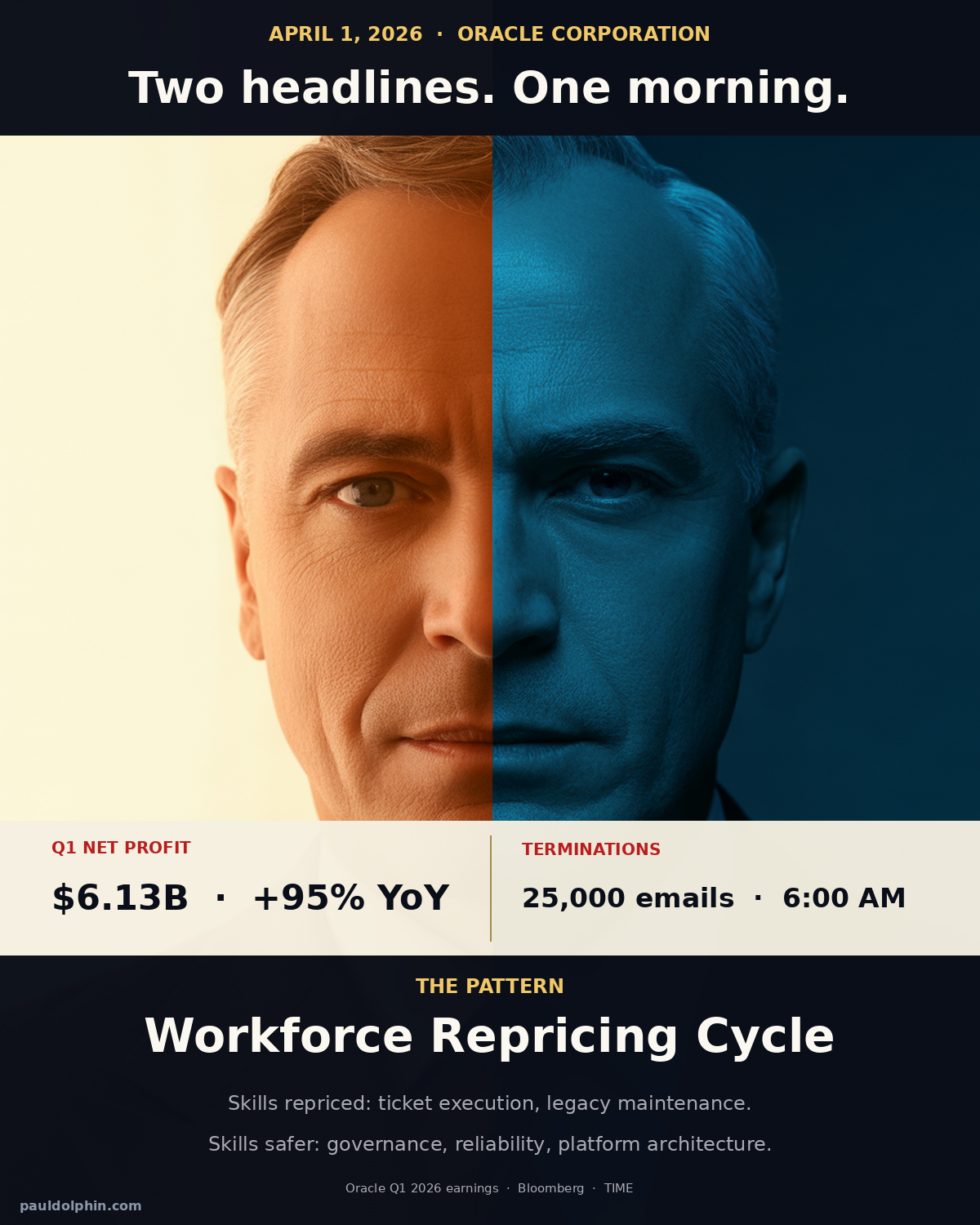
On April 1, 2026, Oracle reported $6.13 billion in net profit. Up ninety-five percent year over year.
On April 1, 2026, Oracle sent a 6 AM email to roughly twenty-five thousand employees telling people who had been there ten, fifteen, nineteen years that their roles had been eliminated.
Sit with that. The two sentences are not in conflict. That's the entire point of this piece.
This is not a layoff cycle.
Roughly ninety thousand tech jobs were eliminated between January and April. Amazon cut sixteen thousand corporate roles in the same quarter AWS grew twenty-four percent . Its fastest pace in thirteen quarters. Meta announced eight thousand cuts effective May 20 alongside guidance for massive AI infrastructure spend. Atlassian eliminated sixteen hundred roles in content creation, customer support, QA, and project management, and in the same announcement said they would be hiring eight hundred new AI engineering roles.
If you only watch the headlines you see layoffs. If you read the financial filings the same week you see something different. You see a single coordinated motion. Bloomberg named it cleanly: roughly half of the AI-attributed cuts will result in the same roles being rehired . Offshore, or at lower salaries. The other half just don't come back.
The industry is not contracting. The industry is repricing the people inside it.
That is the Oracle pattern. Profit and elimination on the same calendar day, drawn from the same balance sheet, attributable to the same operational logic. Call it the workforce repricing cycle and the next two years stop feeling chaotic and start feeling readable.
Read the cuts. They tell you which side you are on.
Look at the Oracle eliminations. The roles that disappeared were legacy database administrators and on-premises support teams. The roles that did not disappear were Kubernetes engineers, platform engineers, the people governing AI inference infrastructure, the people designing how AI workloads get reliable, observable, and safe at scale.
The median time-to-hire for a senior engineer in the Bay Area went from thirty-eight days in Q3 2025 to sixty-seven days in Q1 2026. That number is real and it is uncomfortable. But cloud infrastructure and DevOps engineers are explicitly on the "still hiring aggressively" list. Somebody has to run the workloads everybody is suddenly funding.
The pattern repeats across the layoffs. Roles getting safer:
- Governance.
- Reliability.
- Platform architecture.
- AI infrastructure design.
Roles getting repriced:
- Ticket execution.
- Legacy systems maintenance.
- Jobs where the primary value was doing the thing rather than designing how the thing gets done at scale.
One Oracle employee told TIME this week: "They had us train the AI, then used the AI to replace us."
That sentence will live in my head for a while. Not because it is shocking . It is not. Because it is precise. The employees who trained the AI were on the execution side. The employees who designed the systems the AI is now embedded in are still there.

The two sides of every AI deployment
Think about what an AI system actually requires to ship. There is the work of producing the artifact . The model output, the support response, the QA case, the content piece . And there is the work of designing the system that produces the artifact reliably, governs its failure modes, attributes its outputs, and scales it across an organization.
The first kind of work is execution. The second kind of work is design.
For most of the last decade execution work was where the leverage was. You hired engineers, content folks, QA, project managers because volume mattered and humans were the cheapest way to produce volume.
That math has inverted. Production volume is now cheap. What is expensive . And what nobody has figured out how to automate . Is the design layer above the volume. Governance. Architecture. Reliability. The judgment of what is worth producing and how to make sure the producing process does not become a liability.
The companies doing well right now are not the ones with the most workers. They are the ones with the cleanest design layer between the AI systems doing the work and the humans owning the outcomes.
What the Oracle pattern means for you
Read your own job through the Oracle pattern.
If the answer to "what do I do all day" is I produce the artifact, you are on the side getting repriced. That is not a moral judgment. It is a market fact. The economic value of producing the artifact is going to zero faster than your career timeline can absorb.
If the answer is I design the system that produces the artifact reliably at scale, you are on the side getting safer. Not safe. Safer. Even the design layer will compress eventually. But the compression cycle is years not months.
The actionable middle ground for everyone else: every quarter, ask yourself one question. What did I build, ship, or invest in this quarter that moves me one step from execution toward design?
Documentation of a system. Governance of a process. Reliability instrumentation on a workflow. A reusable framework instead of a one-time deliverable. Mentorship that scales someone else. An automation that retires your own ticket queue. A policy proposal. A measurement framework.
You do not need to be Chief AI Officer. You need to make sure the sentence written about you next April is not the one written about the Oracle employees this April.
The earworm
I keep coming back to this: "They had us train the AI, then used the AI to replace us."
It is so clean. It is so precise. And it is so avoidable.
The avoidance is not finding a company that loves you. The avoidance is doing work where the value created is in the design of the system, not in the operation of it.
That is the question for this quarter. Not whether AI is going to come for your job. AI is going to be in your job either way. The question is whether you are on the side designing how it comes, or on the side being replaced by what comes.
What did you invest in this quarter that puts you on the design side?
Paul Dolphin builds applied-AI infrastructure at the design layer. Numbers in this piece are sourced from Oracle Q1 2026 earnings, Bloomberg labor-market analysis, Meta and Atlassian public announcements, and a TIME report on Oracle's April eliminations.